

Clarksburg School eighth grader Luke Ferris, 14, speaks about the letter he and his classmates wrote to Gov. Maura Healey and Lt. Gov. Kim Driscoll asking for continued funding to rural schools.

https://www.berkshireeagle.com/news/northern_berkshires/clarksburg-students-rural-aid-schools/article_092242a4-3e91-412f-b8f4-37bde52cf32a.html

CREDIT: Gillian Heck, Berkshire Eagle
  • CLARKSBURG — Clarksburg eighth-graders have joined a movement to secure an increase in rural aid to schools across the state.

    Students in Mark Karhan’s history class at Clarksburg School spent this week writing letters to state lawmakers, including Gov. Maura Healey, Lt. Gov. Karen Driscoll and state Rep. Aaron Michlewitz, chair of the House Ways and Means Committee.

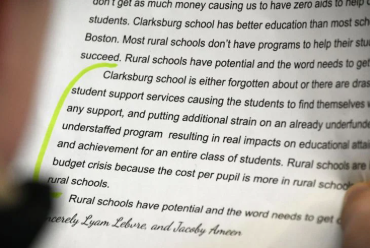
    a close up of a letter written by a student

    One of several letters written by Clarksburg School eighth graders to Gov. Maura Healey and Lt. Gov. Kim Driscoll asking for continued funding to rural schools in the wake of budget cuts from the state and federal government.

    Those letters not only urge support for an additional $4 million in rural aid to school program, but explain why it’s important. Thursday, with local news media and North Berkshire School Union Superintendent John Franzoni in attendance, students read from their letters, making points they hope will convince Legislative leadership.

    In the current fiscal year, the Legislature appropriated $12 million to the rural aid program, cutting the $16 million Healey proposed for the program. This year, Healey is asking for $20 million.

    Meanwhile, rural districts continue to point to a 2022 report that called for a massive increase in rural education aid — $60 million — as a future goal.

    clarksburg student speaking about her letter

    Clarksburg School eighth grader Lexi Senecal, 14, speaks about the letter she and her classmates wrote to Gov. Maura Healey and Lt. Gov. Kim Driscoll asking for continued funding to rural schools in the wake of budget cuts from the state and federal government.


  • “We're making cuts at every school” in the North Berkshire Union’s four districts, Franzoni said Thursday. He explained that Clarksburg is no exception: The school might be asked to make do with one pre-kindergarten room instead of two next year, because it can’t afford to hire a replacement for one of the two pre-K teachers.

    “We have a reduction in our revenue, and we have an increase in our costs, and we can't cover it, given the situation,” Franzoni said.

    It just so happens that the letter-writing campaign, part of a larger "Rural and Declining Enrollment Schools Week of Action," also coincides with Karhan’s annual unit on civics and citizen participation.

    A poster reads, "Small School Big Heart."

    One of several posters created by Clarksburg School eighth graders to Gov. Maura Healey and Lt. Gov. Kim Driscoll asking for continued funding to rural schools in the wake of budget cuts from the state and federal government.
    Karhan’s students teamed up in groups and took turns reading excerpts from their letters.

    They cited the importance of rural schools such as Clarksburg Elementary School as community centers and employers, the difficulties of raising tax revenue in small towns with largely residential tax bases, and the difficulty of attracting teachers to rural schools.

    One student noted that Clarksburg can't afford intervention specialists for both math and English Language Arts, meaning one person must help students in both subject areas. Others pointed out that their school is a hub for community events, from the annual Haunted Hayride to town meetings where residents vote on important issues. Afterwards

    , students, including Lexi Senecal, Marissa Maynard and Luke Ferris said the experience of writing persuasive letters to lawmakers was worthwhile and rewarding.

    “We're such a small school and not a lot of people know about us, not a lot of people even know about Clarksburg,” Maynard said. “Getting us out there, and more people knowing about us, we might have a greater chance of getting more funds or having more people coming up to Clarksburg. "And

     Ferris said he’s confident that the campaign will help his school “get the money that we need to just really help our school build itself back up and regain its resources over the summer.”

    A coordinated campaign taking part this week saw students from other Western Mass. communities reliant upon rural school aid writing lawmakers, and in some cases visiting the Statehouse to make the case in person. State

     Sen. Paul Mark, D-Becket, said the state Senate has generally been a stronger supporter of rural school aid in his years on Beacon Hill — which included six terms in the House. He said he was disappointed the aid was cut to $12 million last year, but is grateful that Healey has proposed an increase to $20 million in her initial budget.

    “If we can deliver on that, it will give a much-needed boost to local schools and that’s what we’re going to be fighting for in the Legislature right now,” Mark said. He also said he’s hoping for a larger share of Fair Share Amendment dollars — the state’s so-called “millionaires tax” — being set aside for education for fiscal 2027.

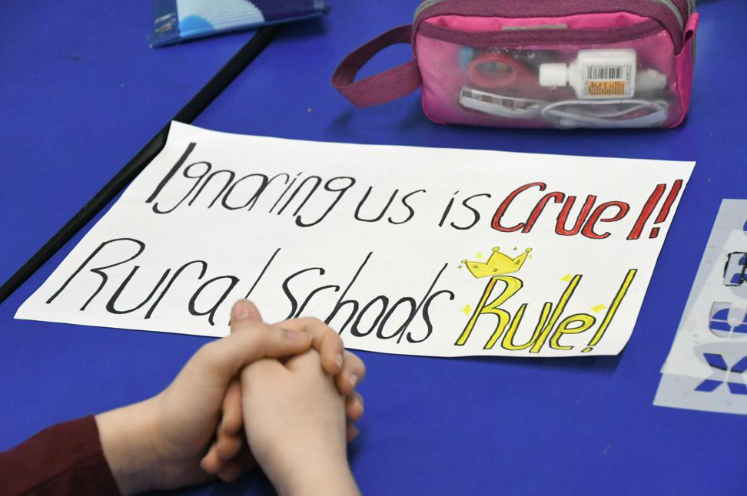
  • student poster that reads "ignoring us is cruel! rural schools rule!"One of several posters created by Clarksburg School eighth graders to Gov. Maura Healey and Lt. Gov. Kim Driscoll asking for continued funding to rural schools in the wake of budget cuts from the state and federal government.


    Last week, the county’s school superintendents held an online meeting with the Berkshire legislative delegation to make the case for rural aid as well as improvements to the Chapter 70 state education aid formula and state support for special education services.

    A poster made by a student reads, "Rural School, Big Heart."

    Clarksburg School eighth graders made posters and wrote letters to Gov. Maura Healey and Lt. Gov. Kim Driscoll asking for continued funding to rural schools in the wake of budget cuts from the state and federal government.

    Multiple lawmakers and school officials have said Chapter 70, which uses a per-pupil formula to distribute aid, is flawed for rural and urban districts that have lost enrollment and has not kept pace with inflation.

    Mark is hopeful that Chapter 70 and the Student Opportunity Act will be reviewed and improved by the Legislature in time for the next budget. State Rep. John Barrett III, whose 1st Berkshire District includes Clarksburg, feels the same way.

    The Student Opportunity Act was written to add funding for low-income students, students of color and English language learners. It was well-intentioned, Barrett said, but “It’s not fully funded.”

    “I believe we can do better this time around” in re-authorizing the Chapter 70 formula, Barrett said. He noted that a commission has been seated to look at potential improvements.

    “We’ve got to change the formula. That’s the bottom line to all of this.”